
by Ella Brolly
#Open call article 2: This blog is part of an ‘open call’ to researchers, students or anyone interested in ethnobotany to write an article for the SEB student blog. Here’s the second article from this call!

Food is the trademark of culture. It is the language we all speak, the thing that transports us home when home is far away. A sensate trigger that can hold the essence of a culture and its roots on the tip of your tongue. All too often we forget the long written dialogues beneath the flavours that fill our plates, an age old conversation between seed and sun, hand and hoe, earth and sky. Let us pay homage to the cultures, the histories, the ancestral pathways our food has travelled on its journey to coming to our graces and filling our lives with flavour.
Make no mistake, vanilla is no hearty meal. It is not the foodstuff that will fill your belly or feed your family. But it is the heady aroma that takes hold of your tongue, your imagination and won’t let go, the sweet scent we long to smell drifting in on the breeze. And for these reasons it is important. It is a flavour which has captivated minds, becoming an international sensation and dominating global markets with a capital value of over $5.2 billion.
Not a bean at all, this slender pod is in fact a fruit, the only known edible fruit of the orchid family’s 20 000 species. The word itself ‘vanilla’ has today come to mean ordinary. Something perhaps lacking in lustre or substance but essentially mundane. The story of Vanilla is anything but, once heralded as the scent of the gods, mixed with cacao, offered up as cacahual, a drink of divine intent. How has this word, namesake of a plant steeped in folklore, medicine, mystery and history fallen so far from our favour? Here I put forward an argument for otherwise.
Vanilla comes from Totonac culture, the people of present day Vera Cruz Mexico who married her with cacao and utilised her potency as medicine and powerful spiritual ally. In Totonac, Vanilla is called “caxixanath”, the recondite flower (impossible for ordinary knowledge to comprehend).
In Vera Cruz she’s still used medicinally today to cure fever and pains in the womb and stomach. Throughout history, from indigestion to head lice, fatigue to ‘odour in the armpits’, Vanilla has been used for countless ailments of the mind and the body. She’s been known to treat stomach and lung disorders when ground or as a poultice to draw out insect venom and infections when fresh. She was included in the very first medicinal text book known to the Americas by an Aztec doctor in 1552 in ‘the travellers safeguard’, mixed with other herbs to promote sleep and even in a lotion used ‘against fatigue of those holding public office’.
Like many other sacred plants however, her majesty was swept up when it reached the hands of colonial control. She is now the second most expensive spice in the world after saffron, known by some as ‘green gold’. Built on markets which fill the pockets of big business and not those who tend to her. Each pod now has a 1 in 10 chance of ending up in a Coca Cola can.
Vanilla was celebrated by the Totonac peoples for its divine, spiritually enhancing qualities. When colonised by the Spanish however, her divine gifts were somewhat fetishised and many associations with vanilla sexualised. They named her vainilla, meaning little ‘vaina’ or sheath (close-fitting cover), coming from the latin word for vagina. The orchid (which gives us vanilla) comes from the Greek ‘orchis’ meaning testicle.
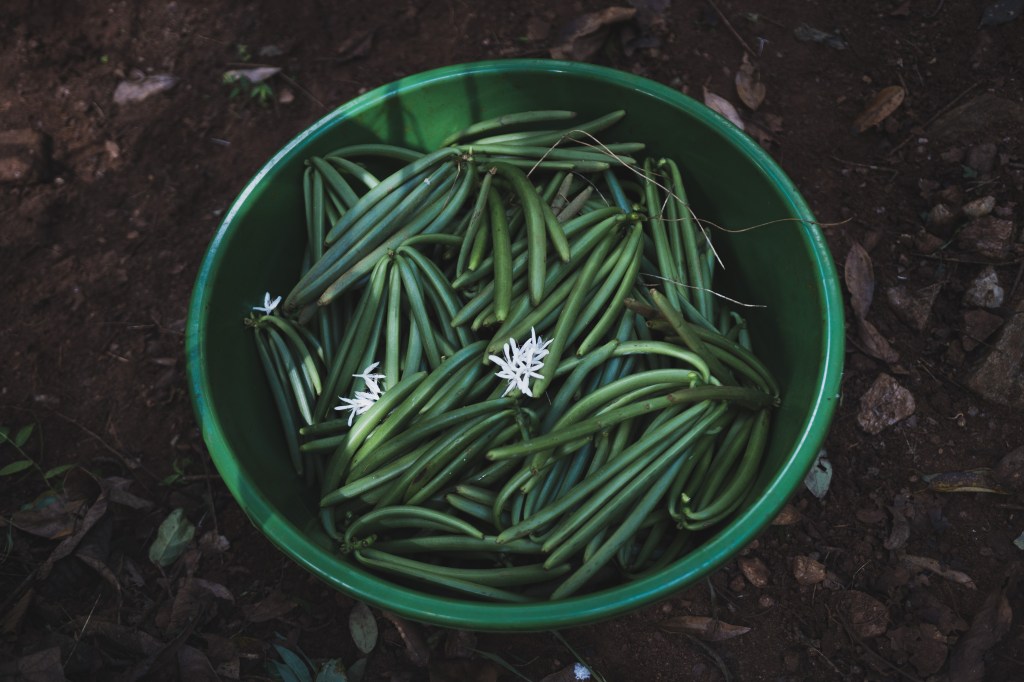
Aside from the history books however, as a sensate flavour, built on aroma and taste, Vanillas true magic is one best experienced directly. I met the Vanilla vine on a trip to the Sri Lankan midlands. Her scent met me first, cutting sweetly but unmistakably through the forest. I follow my nose and find rows on rows of the pods laid out in the sun, slowly blackening, shrivelling like slender prunes, alongside what looks like some unrecognisable green beans. It quickly dawns on me however that these green pods are not beans, but in fact sibling to their slightly more wrinkled and shrivelled counterparts, merely several weeks behind in their newly begun fermentation process.
In Sri Lanka, I witnessed the care and dedication of this fermentation process. The pods initially boiled over an open fire to an exact temperature of 65 degrees for 4 minutes, then sealed briefly in a plastic bag before beginning their maturation process. Each day the pods were carefully rolled out to bask in the sun, slowly darkening and ripening, their scent becoming more potent and intoxicating. Although vanillin is the key flavour compound and the star of the show, there are over 200 other flavour compounds that develop alongside it giving vanilla fruit her unique depth of flavour. The full fermentation process takes 9 months and many producers of vanilla rush or try to cheat this process, or chemically accelerate in lab conditions. When rushed, vanillin will indeed be stimulated, however the many other flavour compounds will be lost, massively reducing the complexity and depth of flavour.

After being hooked on the scents of their harvest, the kind stewards of this bounty, Thushara, Kamani and Madhushika invited me along with them the following morning. We harvest Vanilla planifolia, the two year old vines that have been planted in this stretch of the Kandyan midlands. The harvest is swift but done with attention and skill. I can see the relationships formed with these young vines, just over 1 year old, nurtured here by the hands which planted them. The pods form in clusters, easily plucked and completely scentless before their long fermentation process.
I watch as Thushara surveys the plants, finding those with mature blooms. Delicate and intricate arrangements, she skillfully hand pollinates each one. I am in awe of the sheer volume of this task, hand pollinating every individual flower here is not light work. She performs a tender surgery, slicing open a small section, lifting a miniature flap and finishing with a pinch.
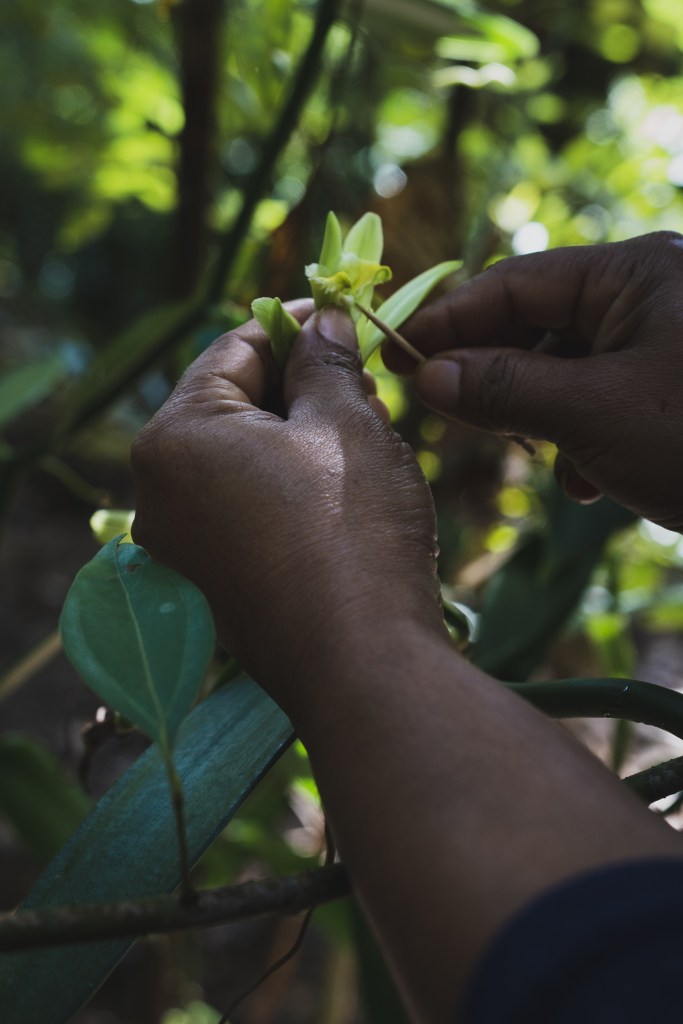
The flowers of the vanilla vine are indeed tender, with short 12 hour blooms, its sole pollinator the mepolina bee, native to the indigenous lands of the Totonac peoples. The flower puzzled and frustrated colonists for around 300 years, desperate to capitalise on its gifts but puzzled by its mechanism. They could not figure out how to forge fruits from this plant away from its pollinator. Finally however, in 1841 the technique of hand pollination was invented by Edmond Albuis, an enslaved 12-year-old from the Reunion islands. A boy who was not is his lifetime accredited for his discovery, despite enabling the explosion of the globalised vanilla industry which exists today.
Today, this technique is still used to produce Vanilla in temperate regions all over the world, including where I witnessed in Sri Lanka. 80% will be produced in Madagascar and only a tiny fraction is still pollinated by the mepolina bee in Mexico.

I have told much of Vanillas’ story in my own words or those of others but let us return to something with deeper roots. After all, messages are often best held in the cradle of myth. This tale takes many forms, but one such form goes as so:
Old Totonac lore says that there once was a breathtakingly beautiful woman called Xanat (whose name meant morning star). Some stories say she was the daughter of the goddess of fertility others say she was of esteemed noble blood, but all stories say that Xanat fell in love with a common man. One day, Xanath was on her way to meet Tzarahuin, her lover, when her beauty caught the eye of the god of Happiness. When the god confessed his love to her, she refused, her love of Tzarahuin too pure and her heart too strong. The stricken god went to visit her father, and as an exchange, shared with him deep secrets of the gods for her hand. Her father ordered her to leave her lover and marry, but Xanath refused. In a rage the god slayed her where she stood. From where her blood fell, a vine began to grow. A vine with delicate white flowers of scent equal to her beauty which blooms in the light of the last morning star. When Tazarahuin found out about the death of his lover, he was distraught. In his grief he took his life at the foot of this plant.
It is said that Tzarahuin comes back as the mepolina bee, to tenderly pollinate the delicate flowers and make love to morning star where none can separate their union.
All too often, the value of a plant, food or medicine becomes swept up by the mechanisms of the modern world, considered primarily as a cog in a market system, a system which holds extraction at its core. Taking without consequence sadly, is the bedrock of modern capitalist systems. A bedrock which doesn’t make solid ground on which rich fruits might ripen. As this story reminds us, we cannot take unjustly without consequence. As the mepolina bee and the vanilla orchid exist together, holding each other’s life forces strong, we remember there is beauty in reciprocity, there is resilience in resistance and there is perfume even in tragedy.
In the words of Martin Shaw ‘we make things holy by the kind of attention we give them’. Perhaps if we held a little more reverence for that which is sacred, the stories, cultures and love of the natural world which has carried these gifts through time to our dinner plates, we might savour our blessings a little deeper, live a little fuller in gratitude, waste less and listen more.
With credit to Thushara, Kamani and Madhushika who invited me to their harvest, and Eko-land produce for their ethical methods and commitment to forest restoration and traditional practices.
Author bio: Ella is a professional grower with a deep seated interest in the intersection between human and plant ecologies. Alongside growing food, she explores ethnobotanical and agroecological themes in her writing and photography, covering topics from spice agroforestry in Sri Lanka to Jamaican seed savers in Tottenham, London. Her commitment to regenerative, healing, land-centred relationships informs every element of her practices.
Link to her work: https://www.ellabrolly.com/spice-forests
Open call: If you also want to contribute an article to the SEB student blog, go ahead and send your plant story to Nishanth Gurav, email: gurav@ftz.czu.cz
Minimum: 500 words, maximum: 2000 words (including pictures) including title and article
 Society for Ethnobotany // Student Blog
Leave a comment